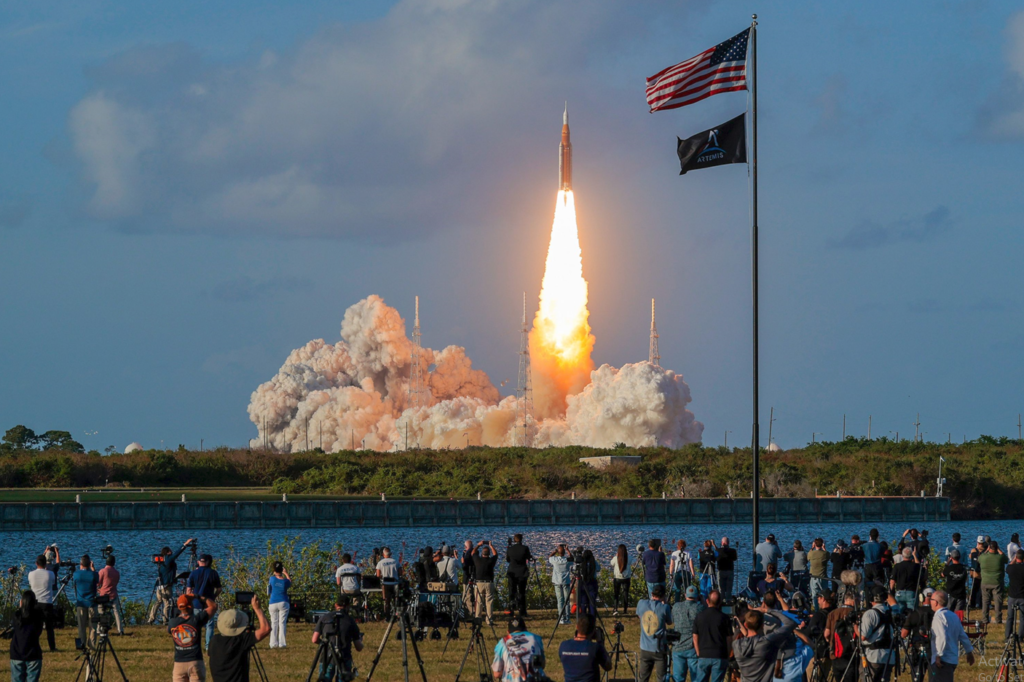
The next chapter of human space exploration is unfolding as NASA pushes forward with its ambitious lunar program. The Artemis II mission, a cornerstone of the broader Artemis Program, represents a historic step toward returning humans to the Moon for the first time since the Apollo 17 Moon landing.
A New Era of Lunar Exploration
Artemis II is designed to be the first crewed mission in the Artemis series. Unlike previous test missions, this mission will carry astronauts aboard the Orion spacecraft, taking them on a journey around the Moon and back to Earth.
The mission’s primary objective is not to land on the Moon, but to test life-support systems, navigation, and deep-space communication technologies with a human crew on board. This is a crucial step before attempting a full lunar landing in future missions.
NASA officials have emphasized that Artemis II is about “proving readiness.” Every system—from propulsion to crew safety—is being tested under real deep-space conditions, ensuring that future missions can proceed with confidence.
Cutting-Edge Technology and Mission Design
At the heart of the mission is the powerful Space Launch System (SLS), the most advanced rocket ever built by NASA. Designed to carry heavy payloads beyond Earth’s orbit, the SLS will propel the Orion spacecraft into deep space.
The Orion capsule itself is equipped with state-of-the-art avionics, radiation protection, and life-support systems. Engineers have spent years refining these technologies to ensure astronaut safety during extended missions far beyond Earth’s protective atmosphere.
One of the most significant challenges is ensuring the spacecraft can withstand extreme temperature variations and cosmic radiation. Artemis II will provide critical data to address these risks, helping scientists better understand how to protect astronauts on longer missions, including potential journeys to Mars.
International Collaboration and Global Competition
The Artemis program is not just a national effort—it is a global initiative. NASA is working closely with partners such as the European Space Agency and other international organizations to build a sustainable human presence on the Moon.
At the same time, Artemis II is unfolding within a renewed global space race. Countries like China are also advancing their own lunar ambitions, aiming to land astronauts on the Moon within the next decade.
This competitive yet collaborative environment is accelerating innovation in space technology, pushing humanity closer to a future where lunar exploration becomes routine rather than extraordinary.
Why the Moon Matters Again
The renewed focus on the Moon is driven by both scientific and strategic goals. The lunar surface holds valuable resources, including water ice, which could be used to produce fuel and support long-term human habitation.
Scientists are also eager to study the Moon’s geology to better understand the early history of the solar system. By establishing a sustained presence on the Moon, researchers can conduct experiments that are not possible on Earth.
Moreover, the Moon is seen as a stepping stone for deeper space exploration. Missions like Artemis II are laying the groundwork for future journeys to Mars and beyond.
Looking Ahead
If successful, Artemis II will pave the way for Artemis III, which aims to land astronauts near the Moon’s south pole—an area believed to contain significant water ice deposits.
The mission also carries symbolic importance. It represents humanity’s return to exploration, innovation, and ambition on a global scale. For many, Artemis II is more than just a mission—it is a signal that a new space age has begun.
As the Orion spacecraft prepares for its journey, the world watches with anticipation. The success of Artemis II could redefine what is possible in human spaceflight and inspire a new generation to look toward the stars.