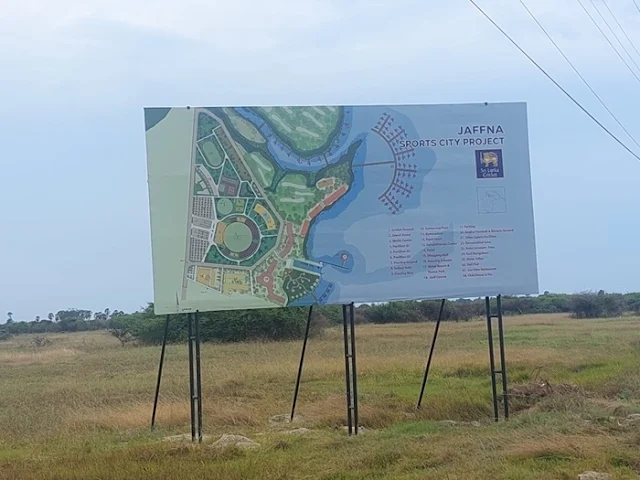
The proposed construction of an international cricket stadium and sports city in Mandaitivu Island, Jaffna, has triggered serious environmental, legal, and social concerns, as large-scale land filling operations have reportedly begun without mandatory environmental approvals.
The project, for which the foundation stone was laid on September 1, 2025, by President Anura Kumara Dissanayake, upon the invitation of Sports Minister Sunil Kumara Gamage, is now under scrutiny for alleged violations of Sri Lanka’s environmental laws and international conservation commitments.
🌿 Destruction of a Critical Wetland Ecosystem
Mandaitivu Island is home to a fragile and ecologically significant wetland system, consisting of mangroves, saline marshes, and brackish water lagoons. These ecosystems play a vital role in biodiversity conservation, climate resilience, and the livelihoods of local communities.
However, approximately 138 acres of wetland area are currently being filled and fenced off to facilitate the construction of the cricket stadium and associated infrastructure, including a golf course, residential complexes, and tourism facilities.
Environmental groups warn that such activities are being carried out without an approved Environmental Impact Assessment (EIA), as required under the National Environmental Act (NEA).
⚖️ Allegations of Legal Violations
According to Section 23B of the National Environmental Act, any development project involving the reclamation of wetlands exceeding 4 hectares (approximately 10 acres) must undergo a formal Environmental Impact Assessment process and obtain prior written approval from the Central Environmental Authority (CEA).
Legal experts point out that failure to comply with these provisions constitutes a criminal offense, punishable under Section 31 of the Act by fines and imprisonment.
Additionally, under Sri Lanka’s antiquities regulations, large-scale land development projects must also undergo archaeological impact assessments, which have reportedly not been conducted in this case.
The silence of regulatory bodies, including the Central Environmental Authority and the Ministry of Environment, has raised concerns over governance and the rule of law.
🐦 A Paradise for Migratory Birds at Risk
The Jaffna lagoon system is internationally recognized as a key habitat for migratory waterbirds along the Central Asian Flyway, one of the world’s major bird migration routes.
Each year, thousands of migratory species such as:
- Glossy Ibis
- Black-tailed Godwit
- Garganey
- Eurasian Wigeon
- Northern Pintail
- Northern Shoveler
arrive in Sri Lanka, with many using Jaffna’s wetlands as their primary feeding and resting grounds.
Studies by the Field Ornithology Group of Sri Lanka indicate that up to 2 million migratory shorebirds utilize the northern wetland systems annually.
The destruction of these habitats could lead to irreversible ecological damage, disrupting migratory patterns and threatening global biodiversity.
🎣 Impact on Fisheries and Local Livelihoods
Beyond biodiversity, the wetlands serve as critical breeding grounds for fish, shrimp, and crab species that sustain the lagoon-based small-scale fishing industry in Jaffna.
Local fishing communities rely heavily on these ecosystems for their livelihoods. Environmental degradation could therefore lead to economic displacement, loss of income, and social instability among coastal populations.
Furthermore, the high water demand required for maintaining cricket and golf facilities raises concerns in a region already facing water scarcity.
Experts warn that prioritizing recreational infrastructure over essential water needs could intensify the region’s water crisis, undermining the basic rights of local residents.
🌍 Violation of International Environmental Commitments
Sri Lanka is a signatory to several international environmental agreements, including:
- The Bonn Convention (Convention on Migratory Species)
- The Ramsar Convention on Wetlands
These treaties obligate the country to protect migratory species and conserve wetlands of international importance.
The destruction of critical habitats in Mandaitivu could therefore place Sri Lanka in violation of its international commitments, potentially affecting its global environmental standing.
🏗️ Development vs Sustainability Debate
While stakeholders agree that the Northern Province deserves equitable development and infrastructure investment, environmentalists emphasize that development must be:
- Legally compliant
- Environmentally sustainable
- Socially inclusive
Critics argue that this project reflects a top-down development approach, lacking adequate public consultation and disregarding ecological sensitivities.
They stress that Sri Lanka must avoid repeating past mistakes, where poorly planned projects led to long-term economic and environmental consequences, as seen in other parts of the country.
⚠️ Call for Immediate Action
Environmental organizations and civil society groups are calling for:
- Immediate suspension of construction activities
- A comprehensive Environmental Impact Assessment
- Public consultation with affected communities
- Identification of alternative locations with minimal ecological impact
They also urge authorities to uphold the rule of law and environmental governance, ensuring that development projects do not compromise the nation’s natural heritage.
🔎 A Test for Governance and Accountability
The Mandaitivu project has now become a critical test for Sri Lanka’s commitment to:
- Environmental protection
- Rule of law
- Sustainable development
As the country seeks to position itself as a responsible global actor, the handling of this issue will send a strong signal about its governance standards and development priorities.