Documents released by the US Department of Justice (DOJ) have sparked global outrage among Muslims, suggesting that pieces of the Kiswah — the cloth covering the Kaaba in Mecca — may have been sent to disgraced financier Jeffrey Epstein.
The documents, published on January 30, 2026, include email exchanges indicating that three Kiswah fragments were shipped from Saudi Arabia to Epstein’s property in the Caribbean in 2017.
🔍 What is the Kiswah?
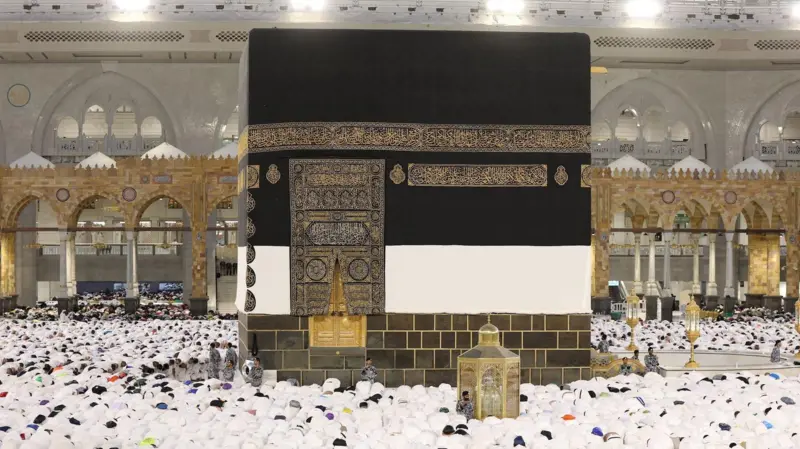
The Kiswah is a black silk cloth that covers the Kaaba, Islam’s holiest site, located in Mecca’s Grand Mosque.
It is embroidered with Quranic verses in gold and silver thread and is replaced annually during Islamic New Year rituals. The old cloth is then carefully removed.
Fragments of the Kiswah are considered highly significant and are typically presented as gifts to prominent Muslim leaders.
📄 What the documents show
According to the released emails, correspondence between Epstein’s staff and an account identified as “Aziza Al-Ahmadi” appears to discuss arrangements for shipping Kiswah-related materials.
These reportedly included:
- a green cloth from inside the Kaaba,
- black cloth from the outer covering, and
- unused embroidered fabric bearing Quranic verses
The documents indicate that the items were delivered to Epstein’s Palm Beach residence in March 2017, before being transported to the US Virgin Islands.
⚠️ Unanswered questions
However, several key issues remain unresolved:
- whether the items were genuine Kiswah fragments,
- whether they were gifted or acquired through other means,
- and the intended purpose of the shipment
The reference in emails to a “mosque” also remains unclear, with no confirmed evidence of such a structure on Epstein’s properties.
🌍 Global reaction
The revelations have triggered strong reactions across social media, with many expressing shock and anger.
Images circulating online, allegedly showing a cloth resembling the Kiswah on the ground, have further fueled criticism, though their connection to the documents remains unverified.
🧭 Expert views
Hajj and Umrah expert Ahmad Al-Halabi stated that Kiswah fragments are typically gifted only to Muslim heads of state and officials.
Dr Simon O’Meara, an Islamic art historian at SOAS University of London, noted that while the Kiswah is not inherently sacred, it holds deep symbolic significance in the Muslim world.
❗ Ongoing concerns
The documents raise significant questions about possible connections between Epstein and individuals linked to Saudi Arabia.
Calls for a full investigation by Saudi authorities are growing, as many aspects of the case remain unclear.