A Comprehensive Investigative Report on the Arrest of Natasha Edirisuriya
The arrest and remand imprisonment of Sri Lankan comedian Natasha Edirisuriya triggered a profound national debate on freedom of expression, rule of law, and the scope of police power in Sri Lanka. Although the controversy appeared to reach a legal turning point on February 19, 2026, when an official expression of “regret” was presented before the Supreme Court of Sri Lanka, the broader constitutional and institutional questions raised by the incident remain unresolved.
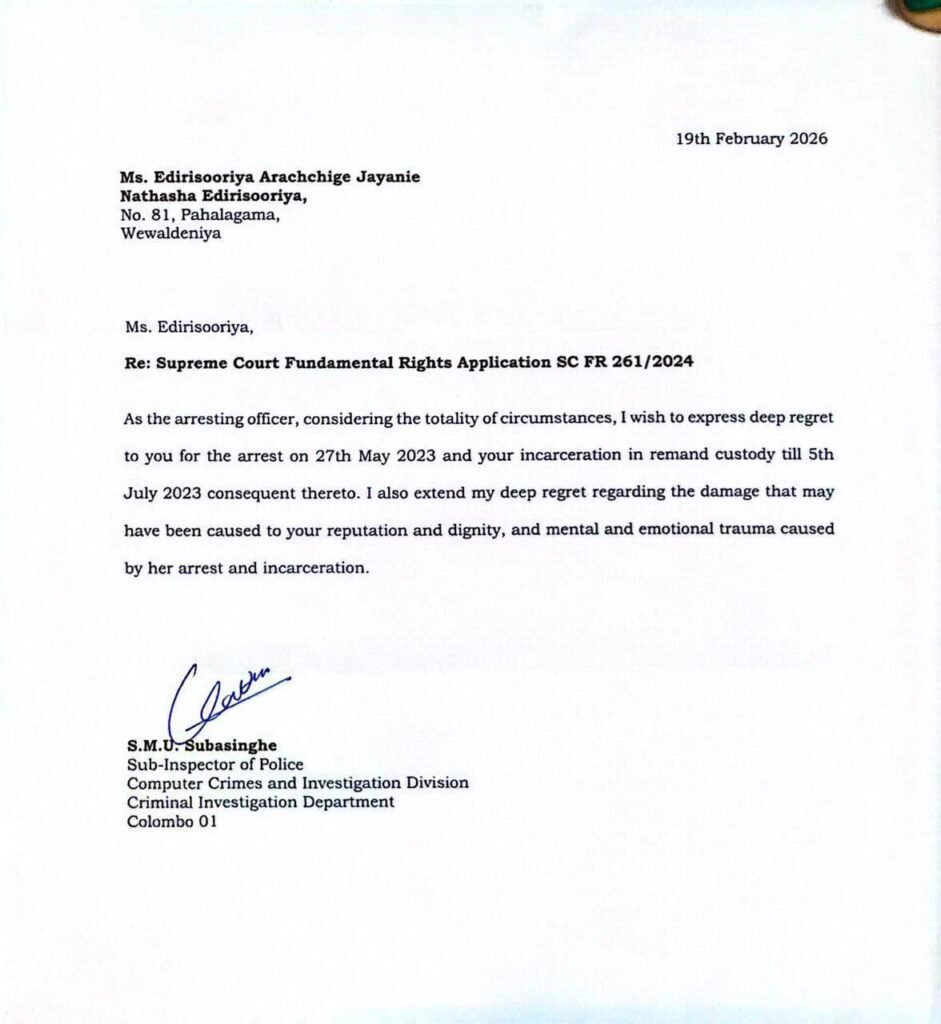
On May 27, 2023, Edirisuriya was arrested at Bandaranaike International Airport following allegations that certain remarks she made during a comedy show titled “Modabhimanaya” had insulted Buddhism. The arrest was carried out by the Criminal Investigation Department (CID), specifically its Computer Crimes Investigation Division. She was subsequently remanded in custody until July 5, 2023, before being granted bail by the High Court of Sri Lanka.
What made this case particularly significant was that the arrest was made under the ICCPR Act, legislation enacted to domesticate the International Covenant on Civil and Political Rights. The ICCPR, adopted by the United Nations in 1966, was designed to safeguard fundamental freedoms including freedom of expression, freedom of religion, protection from arbitrary arrest, and the right to fair trial. The paradox in this case lies in the fact that a law intended to protect civil liberties was instead used to justify the deprivation of liberty.
On February 19, 2026, the former Director of the CID’s Computer Crimes Division submitted a formal statement expressing regret before the Supreme Court in relation to Edirisuriya’s remand detention. The statement conveyed regret over her incarceration and acknowledged that if her reputation or mental well-being had been adversely affected, such consequences were also regrettable. Following this expression of regret, the Supreme Court concluded proceedings relating to the fundamental rights petition filed by Edirisuriya.
However, the legal closure of the case does not necessarily equate to substantive justice. The critical question remains whether a written expression of regret can compensate for the psychological trauma, reputational damage, professional setbacks, and loss of liberty endured during weeks of imprisonment. While the apology may carry procedural significance, it does not fully address the deeper issues of accountability and institutional responsibility.
In response to the controversy, reports indicated that the Inspector General of Police intended to introduce new guidelines governing arrests under the ICCPR Act in order to prevent future misuse. Although such measures may represent a constructive step, critics argue that issuing guidelines after the fact resembles a delayed corrective action rather than proactive institutional reform. Without strengthening legal literacy, critical judgment, and professional independence within law enforcement, written directives alone may prove insufficient to safeguard civil liberties.
The Edirisuriya case exposes broader systemic concerns. It highlights the concentration of arrest powers, the practical consequences of non-bailable provisions, the limited mechanisms for holding officers personally accountable, and the delays inherent in judicial review. When law enforcement authorities appear to operate with minimal personal consequences for questionable decisions, public confidence in the rule of law is inevitably undermined.
These concerns become even more pronounced in light of proposed new security legislation, including the draft Proposed Anti-Terrorism Bill, which seeks to expand the powers of security forces. If existing laws designed to protect rights can be interpreted and applied in ways that restrict them, the expansion of state authority without robust oversight mechanisms raises legitimate constitutional anxieties. Legislative reform, therefore, must be accompanied by safeguards that ensure proportionality, transparency, and judicial supervision.
Freedom of expression remains the cornerstone of any democratic society. It protects not only agreeable or popular speech but also dissenting, satirical, and controversial expression. The suppression of such expression through expansive or politicized interpretations of the law risks eroding democratic culture itself.
Ultimately, the Natasha Edirisuriya case demonstrates that expressions of regret, while symbolically meaningful, are not substitutes for accountability, compensation where appropriate, and structural reform. For the rule of law to retain credibility, those entrusted with enforcing the law must themselves remain subject to it. The enduring lesson of this episode is that democratic resilience depends not merely on legislation, but on the integrity, restraint, and responsibility with which that legislation is applied.